
Have you ever noticed how some days you walk into a room feeling completely different from others?
Nothing major has changed.
You are the same person. You have the same skills, the same experiences, and the same personality.
Yet somehow, you feel more confident.
More comfortable.
More present.
And often, the difference starts with what you’re wearing.
Most people think confidence comes entirely from within. While that is partly true, confidence is also influenced by what surrounds us. Our environment affects how we feel, how we think, and how we behave. Clothing is part of that environment.
This is where clothing psychology becomes interesting.
Because clothes do far more than cover the body. They influence mood, behavior, self-perception, and even the way we interact with the world around us.
Why Clothing Is More Emotional Than We Think
Most purchases are not purely practical.
People rarely buy a jacket simply because they need warmth.
They buy it because of how it makes them feel.
The same applies to a dress, a pair of shoes, or even a watch.
Behind almost every style choice lies an emotional decision.
We choose clothes that make us feel:
- Confident
- Comfortable
- Powerful
- Creative
- Attractive
- Professional
- Authentic
Clothing is often less about fashion and more about emotion.
The outfit itself is rarely the goal.
The feeling it creates is.
The Psychology of Dressing Well
Think about the last time you dressed particularly well for an important event.
Perhaps it was a presentation.
A job interview.
A meeting.
A first date.
Before anything happened externally, something usually shifted internally.
You stood differently.
You spoke differently.
You carried yourself differently.
This is one of the most fascinating aspects of the psychology of dressing well.
When our appearance aligns with the situation, we often feel more prepared to participate in it.
The clothes do not magically create ability.
But they can create a stronger sense of readiness.
And readiness often looks a lot like confidence.
Confidence Begins Before You Speak
Many people assume confidence starts when they begin talking.
In reality, confidence often starts much earlier.
It begins with how comfortable you feel in your own skin.
And clothing plays a role in that experience.
When an outfit feels authentic, people spend less energy worrying about how they look.
They become more focused on what they are saying, doing, and contributing.
This creates a subtle but important shift.
Instead of managing self-consciousness, they can focus on being present.
That presence is often interpreted as confidence.
Why Certain Clothes Feel Like “You”
Almost everyone has that one outfit.
The one they reach for when they want to feel like themselves.
Not because it’s trendy.
Not because it’s expensive.
But because it feels right.
This connection between personal style and confidence is deeply personal.
The clothes that make one person feel powerful might make another feel uncomfortable.
That’s because confidence isn’t created by clothing alone.
It’s created by alignment.
The strongest style choices are often the ones that reflect who we genuinely are rather than who we think we should be.
Can Clothes Change Your Mindset?
This question appears frequently in conversations about style.
The answer is surprisingly nuanced.
Can clothes completely transform your personality?
No.
Can they influence your mindset?
Absolutely.
Research in fashion psychology has repeatedly shown that what we wear can influence behavior, attention, and self-perception.
Think about uniforms.
Think about athletic wear.
Think about formal business attire.
Different clothing often encourages different states of mind.
The reason is simple.
Our brains attach meaning to what we wear.
When we associate certain clothing with professionalism, competence, creativity, or success, wearing those items can reinforce those feelings.
This is one reason why the question “Can clothes change your mindset?” continues to resonate with so many people.
Because often, they can.
Clothing and Self-Image: The Hidden Relationship
The connection between clothing and self image is often underestimated.
Many people think appearance only influences how others see them.
But appearance also influences how they see themselves.
When people consistently wear clothing that feels disconnected from their identity, confidence often suffers.
Not because the clothes are objectively wrong.
But because they create emotional friction.
On the other hand, when appearance feels aligned with identity, people tend to feel more comfortable and self-assured.
Confidence becomes easier when you feel represented by what you wear.
The Difference Between Dressing for Others and Dressing for Yourself
One of the biggest misconceptions about style is that it exists primarily to impress others.
In reality, the most impactful style decisions are often made for ourselves.
When people constantly dress according to external expectations, they often lose connection with their own preferences.
Over time, this can create insecurity.
Not because the clothes are wrong.
But because the identity behind them feels absent.
Dressing for yourself does not mean ignoring context.
It means finding a balance between authenticity and appropriateness.
The goal is not attention.
The goal is alignment.
Professional Image and Everyday Confidence
Clothing becomes especially important in professional environments.
Before someone hears your ideas, they often encounter your presence.
This is where professional image matters.
A professional image is not about looking expensive or fashionable.
It is about creating visual consistency between how you want to be perceived and how you actually show up.
When appearance supports communication, confidence often follows naturally.
People stop worrying about whether they look the part.
They can focus on doing the work.
And that shift can be incredibly powerful.
Expert Insight: Confidence Is Rarely About the Clothes
One common misunderstanding is believing confidence comes directly from clothing.
In reality, confidence comes from what clothing represents.
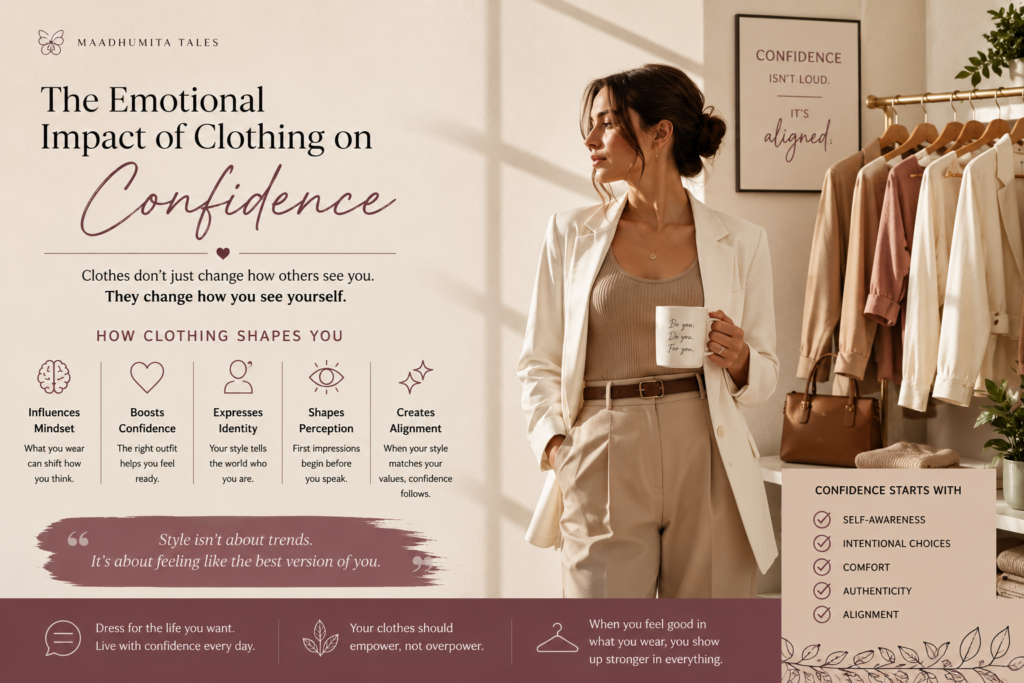
A well-chosen outfit often signals:
- Preparation
- Self-awareness
- Intentionality
- Authenticity
- Alignment
The clothing itself is not the source of confidence.
The alignment is.
This is why two people can wear the exact same outfit and experience completely different levels of confidence.
What matters is whether the clothing feels true to the person wearing it.
The Emotional Cost of Wearing the Wrong Things
Most conversations about style focus on looking better.
A more interesting conversation is about feeling better.
Wearing clothing that feels disconnected from your personality can quietly affect:
- Confidence
- Comfort
- Communication
- Presence
- Self-expression
The effect may be subtle.
But over time, it adds up.
Many people do not need an entirely new wardrobe.
They simply need a wardrobe that feels more like them.
Conclusion
The impact of clothing goes far beyond appearance.
Clothing influences emotions, confidence, mindset, and self-perception in ways we often overlook.
The reason certain outfits feel powerful is not because they change who we are.
It is because they help us access parts of ourselves more easily.
When clothing aligns with identity, confidence becomes less about performance and more about presence.
And perhaps that is the real purpose of style.
Not to become someone else.
But to feel more fully like yourself.
FAQs
1. How does clothing affect confidence?
Clothing influences self-perception, comfort, and emotional readiness, which can strengthen confidence.
2. What is clothing psychology?
It is the study of how clothing affects thoughts, emotions, behavior, and perception.
3. Can clothes change your mindset?
Yes, clothing can influence mood, focus, and confidence through psychological associations.
4. Why is dressing well important?
Dressing well often increases self-assurance and helps create a positive first impression.
5. How does clothing affect self-esteem?
When clothing feels aligned with identity, it can improve self-image and emotional comfort.
6. What is the connection between fashion and psychology?
Fashion influences behavior, emotions, confidence, and how people perceive themselves and others.
7. Does professional clothing improve performance?
Appropriate professional attire can increase confidence, focus, and workplace presence.