You walk into a room.
You join a call.
You meet someone for the first time.
Before you say a word, something has already happened.
A judgment has been made.
This isn’t opinion it’s first impression psychology.
People don’t wait to understand you.
They interpret you instantly.
And that interpretation often stays.
The Reality of First Impressions
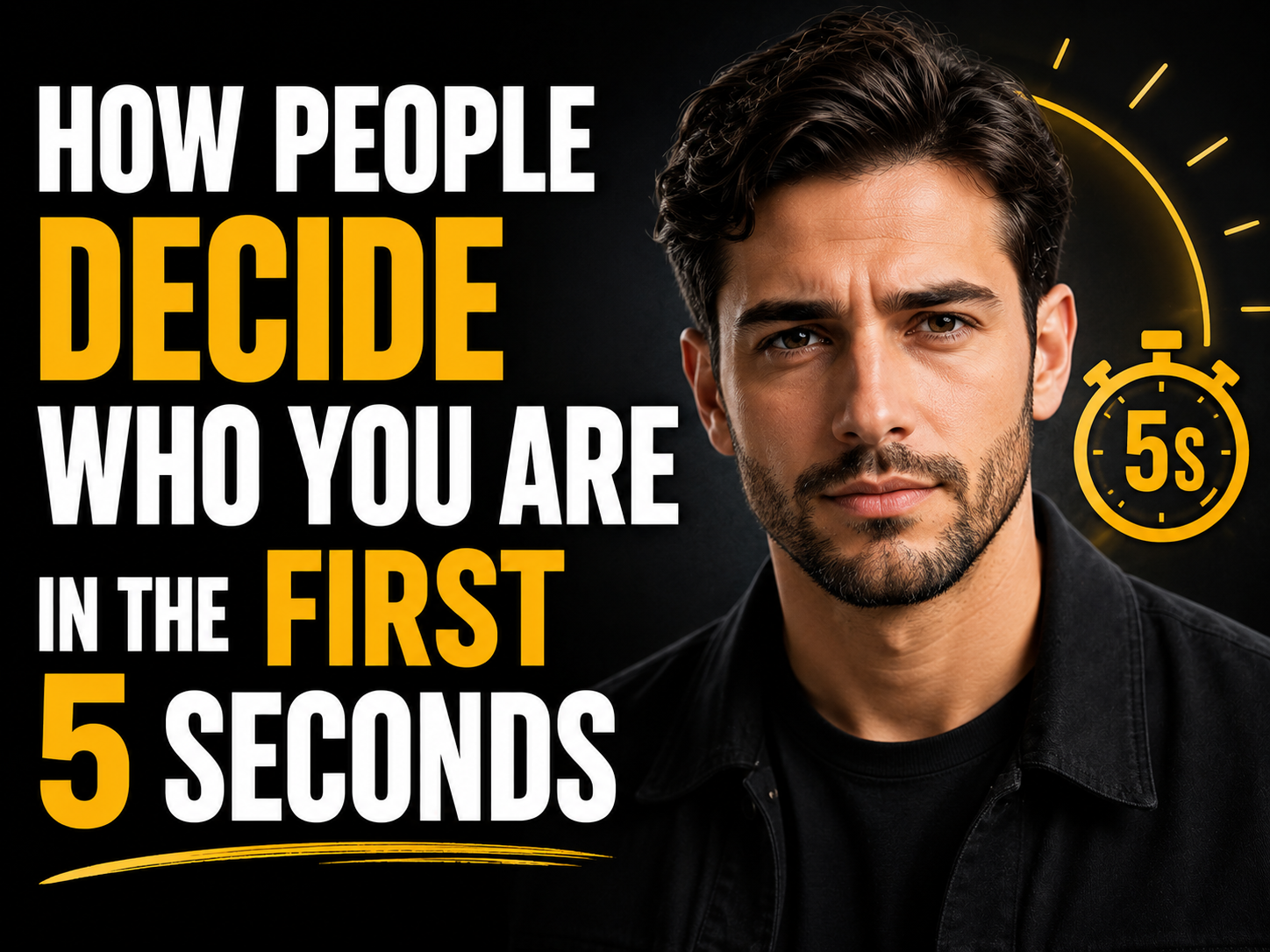
In professional and social settings, people form impressions within seconds.
Not minutes. Not conversations.
Seconds.
This is why understanding how people judge you instantly in business becomes critical especially in a world where attention spans are shrinking and visibility is increasing.
Your professional image is not built over time first.
It is assumed first then confirmed later.
First Impressions Are Not Neutral They Are Contextual
One of the biggest misconceptions about first impressions is that they are objective.
They are not.
They are deeply influenced by context.
- The situation sets the emotional backdrop
- The other person filters you through their own lens
- And you show up with your energy, presence, and cues
Nothing about it is neutral.
A first impression isn’t just about you.
It’s a moment shaped by timing, perception, and environment.
This is where most people misunderstand first impression psychology they focus only on themselves, while ignoring the context in which they are being perceived.
What Actually Happens in Those 5 Seconds
The brain is designed to make quick decisions.
It scans for:
- Familiar patterns
- Visual cues
- Behavioral signals
This is part of human survival instinct.
In modern settings, this translates into silent questions like:
- Can I trust this person?
- Are they competent?
- Do they belong here?
This is the core of the psychology behind first impressions in workplace environments.
People Are Judging Even When You Think They’re Not
Whether we acknowledge it or not, people evaluate quickly.
In those first few seconds, they form opinions about:
- Credibility
- Social and emotional intelligence
- Values
- Economic status
- Conventional intelligence
- Cultural identity
This is not about being critical.
It’s about how human perception works.
And these judgments directly shape your professional image and executive presence.
The Same Judgment Happens Online Just in a Different Form
Many assume that digital platforms reduce judgment.
They don’t.
They simply change how it shows up.
Your online personal branding is constantly being evaluated through patterns.
Credibility
→ Profile quality, consistency, proof of work
Social & Emotional Intelligence
→ Tone in captions, responses, how you engage
Values
→ What you post, what you ignore, what you stand for
Economic Status
→ Visual lifestyle, brand associations, overall aesthetics
Conventional Intelligence
→ Clarity of ideas, articulation, structure of content
Cultural Identity
→ Language, references, styling, digital behavior
Same judgment. Different medium.
Offline — it’s your presence.
Online — it’s your patterns.
Either way, people are reading you before you’ve explained yourself.
This is why the importance of first impressions in personal branding has only increased in the digital era.
Why Your First Impression Stays Longer Than You Think
Once an impression is formed, the brain looks for evidence to support it.
This is known as confirmation bias.
So if someone initially perceives you as:
- Confident → they notice confidence
- Uncertain → they notice hesitation
Your first impression becomes a filter.
And everything after that is interpreted through it.
First Impressions vs Reality
Who you are
≠
How you are perceived
There is always a gap.
And most people are unaware of it.
This is where working with a personal image consultant or developing awareness around perception becomes important not to change who you are, but to ensure alignment.
What Shapes Your First Impression the Most
1. Visual Identity
What people see first:
- Clothing
- Grooming
- Body language
This is the fastest signal your brain processes.
2. Behavioral Presence
How you carry yourself:
- Eye contact
- Energy
- Confidence
This is where executive presence becomes visible.
3. Communication Style
What you say and how you say it:
- Tone
- Clarity
- Delivery
This reinforces or weakens the impression already formed.
Common Mistakes That Damage First Impressions
- Inconsistency between image and message
- Trying too hard to impress
- Lack of awareness about perception
- Ignoring context
These mistakes weaken your professional image and reduce trust.
How to Make a Strong First Impression Professionally
1. Define How You Want to Be Perceived
Clarity creates direction.
2. Align Your Signals
Your appearance, communication, and behavior should tell the same story.
3. Simplify Your Presence
Clarity is more powerful than complexity.
4. Develop Awareness
Pay attention to how people respond to you.
5. Stay Consistent
Consistency builds familiarity and familiarity builds trust.
How to Improve Professional Image Quickly
- Refine posture and body language
- Simplify your visual presentation
- Improve clarity in communication
- Remove unnecessary distractions
Small changes create strong perception shifts.
Expert Insight
Most people believe:
“If I’m good at what I do, it will show.”
But perception doesn’t work that way.
People don’t discover your value first.
They assume it based on what they see.
Conclusion
You don’t get time to explain yourself first.
You get perceived first.
This is the reality of first impression psychology.
The goal is not to control judgment
but to understand it.
Because when your presence, communication, and intent align,
your first impression stops being accidental
and starts becoming intentional.
FAQs
1. How fast do people form a first impression?
Within seconds, often before any meaningful interaction.
2. Can first impressions be changed?
Yes, but it requires consistent and intentional effort.
3. Why are first impressions important in personal branding?
They shape how people understand and remember you instantly.
4. What affects first impressions the most?
Visual cues, behavior, and communication style.
5. How can I improve my first impression professionally?
Focus on clarity, alignment, and consistency.
6. Does online presence affect first impressions?
Yes, your digital behavior and content shape perception just as strongly.