Look around for a moment.
The coffee shop you choose.
The clothes hanging in your wardrobe.
The way your workspace is arranged.
The playlists you listen to.
Even the way you photograph your breakfast.
None of these decisions are purely functional anymore.
Somewhere along the way, aesthetics stopped being a luxury and became a language.
We are living in a time where people are not just consuming experiences. They are curating them. Documenting them. Designing them.
And whether we realize it or not, much of modern life is now shaped by aesthetic psychology.
The question is: why?
Why do beautifully arranged spaces attract us so deeply?
Why do certain lifestyles feel aspirational even when they offer nothing practical?
Why are people spending more time than ever thinking about how things look?
The answer has less to do with beauty and more to do with identity.
The Modern World Is Overwhelming
Human beings have always been drawn to beauty.
But today’s attraction to aesthetics feels different.
Because modern life feels different.
We live in a world filled with constant information, endless choices, and continuous stimulation.
Every day we are exposed to:
- thousands of images
- competing opinions
- breaking news
- digital noise
- social expectations
The result is often psychological fatigue.
Aesthetics offer something that modern life rarely does.
Order.
A beautifully designed room.
A thoughtfully curated wardrobe.
A clean visual feed.
These things create a sense of structure in a world that often feels chaotic.
Sometimes what we call “good taste” is actually a desire for emotional calm.
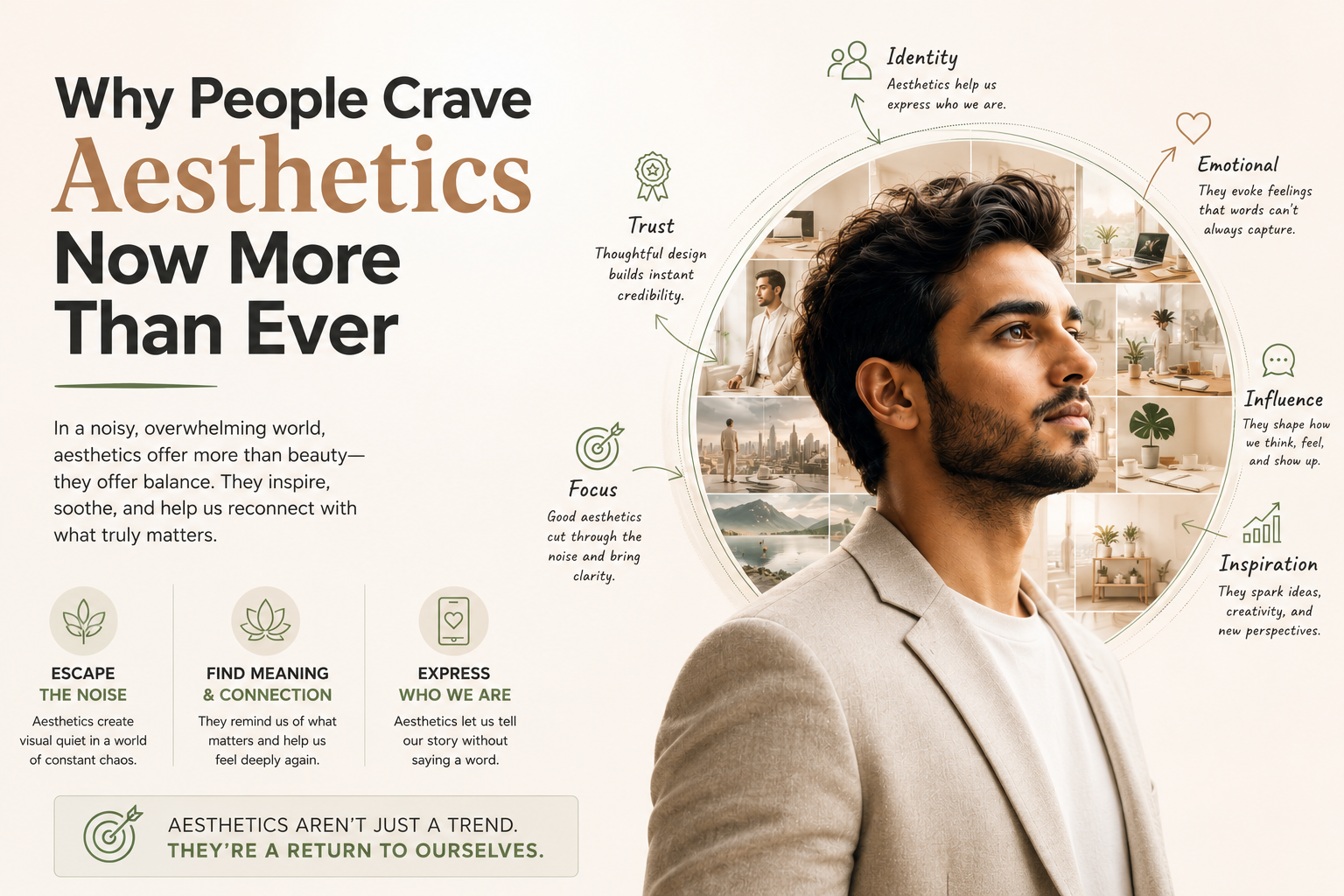
Aesthetics Have Become A Form Of Identity
There was a time when aesthetics primarily reflected status.Today they often reflect identity. People don’t just decorate spaces. They communicate values through them Minimalism says something. Vintage aesthetics say something. Luxury aesthetics say something. Creative chaos says something. Every visual choice becomes a signal.
This is why personal aesthetics have become so important.
People are no longer asking:
“What do I like?”
They’re asking:
“What does this say about me?”
And often, they aren’t even consciously aware of it.
We No Longer Just Live Our Lives. We Present Them
Social media changed something fundamental about human behavior. For most of history, identity was experienced.Now identity is also displayed. This shift has transformed our relationship with aesthetics. Today, a restaurant is not only evaluated by food. It’s evaluated by atmosphere. A destination is not only evaluated by experience. It’s evaluated by how it photographs. Even books, journals, workspaces, and clothing have become visual extensions of identity.
The rise of the aesthetic lifestyle is not simply about beauty.
It is about self-expression. Or perhaps more accurately, self-presentation.
Why Visual Beauty Feels Emotionally Powerful
One of the reasons people are attracted to visual beauty is because beauty creates emotional shortcuts.
Before we understand something intellectually, we often respond to it emotionally.
A beautifully designed environment can make us feel:
- calm
- inspired
- sophisticated
- creative
- hopeful
Without saying a single word.
This is where perception psychology becomes fascinating. Human beings rarely interpret visuals as neutral. We assign meaning to them. A clean workspace may signal discipline. A thoughtfully styled outfit may signal confidence. A carefully designed brand may signal credibility. Whether accurate or not, perception forms instantly. And perception influences behavior.
The Difference Between Reality And Perception
One of the most interesting aspects of aesthetics is that they don’t always reflect reality.
Sometimes they create it.
A person may appear confident because they dress confidently.
A business may appear established because its visual identity feels polished.
A lifestyle may appear fulfilling because it is aesthetically pleasing.
This doesn’t necessarily mean the perception is false.
But it highlights an important truth.
People often respond to what they see before they understand what is actually there.
This is why image and perception have become so intertwined.
In many situations, aesthetics become the introduction before substance gets the opportunity to speak.
Expert Insight: The Real Reason Aesthetics Matter
Many people assume aesthetics are superficial.
In reality, aesthetics are often psychological.
They influence how we feel about ourselves.
They influence how others interpret us.
And they influence the environments we create around us.
The strongest use of aesthetics isn’t about impressing people.
It’s about creating alignment.
When someone’s appearance, environment, communication, and values feel connected, authenticity becomes easier to perceive.
This is why aesthetics become especially important in personal branding, leadership, and professional presence.
Not because appearance replaces substance.
But because appearance often becomes the first signal of it.
Why Aesthetics Matter In Modern Life More Than Ever
The modern world places enormous importance on visibility.
People are constantly being observed.
Online and offline.
Professionally and socially.
As a result, aesthetics have become part of how people navigate identity.
The way you present yourself influences:
- credibility
- trust
- memorability
- emotional connection
This doesn’t mean everyone needs to pursue perfection.
But it does mean visual choices carry meaning.
Whether intentional or not.
And the people who understand this tend to communicate more clearly.
The Hidden Risk Of Chasing Aesthetics
Of course, aesthetics can become a trap.
When appearance becomes more important than authenticity, identity becomes performative. Many people today feel pressure to maintain a certain image.
A certain lifestyle. A certain aesthetic. Even when it no longer reflects who they are. This is where self-awareness becomes important. Because aesthetics should ideally express identity. Not replace it. The goal is not to become visually perfect. The goal is to create alignment between who you are and how you are perceived.
Conclusion
The growing fascination with aesthetics is not really about beauty.
It is about belonging.
Identity.
Expression.
Control.
Meaning.
In an increasingly noisy world, aesthetics help people communicate who they are without speaking.
They create emotional impressions before conversations begin. They shape perception before understanding arrives. And perhaps that is why aesthetics matter more now than ever before. Because modern life has made identity increasingly visible. And aesthetics have become one of the primary ways people choose to tell their story.
FAQs
1. What is aesthetic psychology?
Aesthetic psychology explores how visual experiences influence emotions, perception, decision-making, and human behavior.
2. Why do aesthetics matter in modern life?
Aesthetics help people express identity, create emotional experiences, and influence how they are perceived by others.
3. Why are people attracted to visual beauty?
Visual beauty creates emotional responses, reduces cognitive effort, and often signals meaning, quality, or credibility.
4. How do aesthetics influence perception?
People often form judgments based on visual cues before gathering deeper information, making aesthetics a powerful perception tool.
5. What is an aesthetic lifestyle?
An aesthetic lifestyle refers to intentionally curating experiences, environments, and personal presentation around a specific visual identity or value system.
6. How do aesthetics affect personal branding?
Aesthetics help communicate identity, values, professionalism, and credibility before verbal communication begins.
7. Can aesthetics impact confidence?
Yes. The environments we create and the way we present ourselves can significantly influence self-perception and confidence.