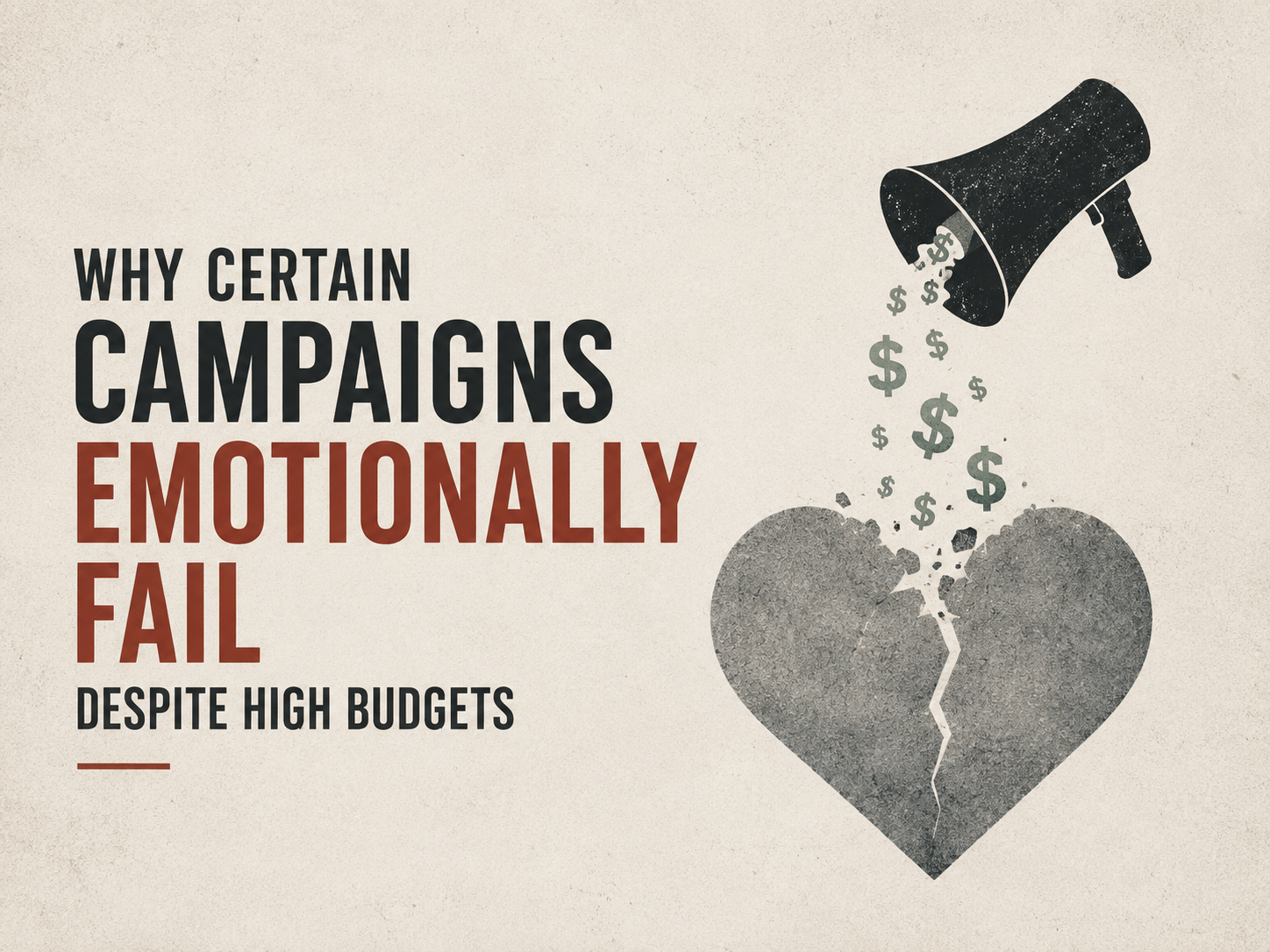
Every year, brands spend millions trying to capture attention. Campaigns become bigger, visuals become more cinematic, celebrity endorsements become more expensive, and technology makes it possible to create almost anything imaginable. Yet despite all this investment, many campaigns quietly disappear from public memory within days.
We’ve all experienced it. A campaign launches with enormous anticipation, dominates conversations for a brief moment, and then vanishes without leaving any real impression. Meanwhile, another campaign, often with a fraction of the budget, continues to be remembered, discussed, and referenced years later.
The difference is rarely production quality.
The difference is emotional relevance.
People don’t remember campaigns because they were expensive. They remember them because they felt something. A campaign becomes memorable when it reflects a truth people recognize within themselves. Without that emotional connection, even the most sophisticated marketing effort risks becoming background noise.
The Misunderstanding at the Heart of Modern Marketing
One of the biggest misconceptions in branding is the belief that attention automatically leads to connection. It doesn’t.
Attention can be bought. Visibility can be engineered. Reach can be amplified. But emotional engagement operates differently. It cannot be purchased through larger budgets or manufactured through better production alone.
Many campaigns are designed around what a brand wants to say rather than what an audience is feeling. They focus on communicating messages, features, or achievements, while overlooking the emotional realities of the people they hope to reach.
As a result, audiences may notice the campaign, but they don’t carry it with them.
And if a campaign isn’t remembered, its impact is often far smaller than the numbers suggest.
Why Human Beings Remember Feelings More Than Messages
Long after we’ve forgotten a slogan, we often remember how something made us feel.
We remember the advertisement that reminded us of home. The story that reflected a relationship we valued. The campaign that articulated something we had experienced but never fully expressed.
This is where emotional branding becomes powerful.
At its best, branding is not about persuading people. It’s about helping people feel understood. When a campaign mirrors an emotion, a struggle, an aspiration, or a shared cultural experience, it stops feeling like marketing and starts feeling meaningful.
Meaning creates memory.
And memory creates connection.
Most Campaigns Talk About The Brand Too Much
Ironically, many campaigns fail because they place the brand at the center of the story.
People are not naturally interested in brands. They are interested in their own lives. Their ambitions, insecurities, relationships, identities, and experiences.
The campaigns that create genuine emotional connection understand this distinction.
Instead of asking, “How do we make people notice us?” they ask, “How do we make people feel seen?”
The difference may sound subtle, but it completely changes the outcome.
When people recognize themselves within a story, they become emotionally invested in it. The brand becomes memorable not because it demanded attention, but because it created recognition.
The Role of Consumer Psychology in Campaign Success
Every successful campaign begins with an understanding of human behavior.
People rarely make decisions based purely on logic. Emotions, perceptions, memories, and social influences shape how we interpret the world around us. This is why consumer psychology often matters far more than production budgets.
The strongest campaigns don’t simply communicate information. They understand what their audience fears, hopes for, values, and aspires toward.
They recognize that people are constantly asking questions such as:
- Do I belong here?
- Does this reflect who I am?
- Can I trust this?
- Does this understand my reality?
Campaigns that answer these questions emotionally create stronger relationships than campaigns focused solely on selling.
Why Storytelling Still Matters
The word “storytelling” has become so common in marketing conversations that it sometimes loses its meaning.
But stories remain powerful for one simple reason: they help people make sense of themselves.
A good story isn’t memorable because it’s creative. It’s memorable because it feels true.
People connect with stories that reflect something they already know deep down but may not have articulated. They connect with stories about identity, belonging, ambition, love, loneliness, hope, and change.
This is why some campaigns resonate across cultures and generations. The emotional truth beneath the story feels universal.
And emotional truth will always outperform clever messaging.
Expert Insight: Emotion Cannot Be Added at the End
Many campaigns treat emotion like a finishing touch.
The strategy is developed. The messaging is finalized. The visuals are produced. Then, somewhere near the end, an attempt is made to “make it emotional.”
But emotion doesn’t work that way.
Emotion is not a layer added to a campaign. It is the foundation it should be built upon.
The most impactful campaigns begin with a human insight. They start by understanding what people are feeling before deciding what the brand wants to communicate.
When emotional understanding comes first, the campaign feels natural.
When it comes later, it often feels forced.
Why Some Campaigns Stay With Us for Years
Think about the campaigns you still remember years after seeing them.
Chances are, you don’t remember every detail. You probably don’t remember every visual or every line of copy.
What you remember is the feeling.
Perhaps it made you nostalgic. Perhaps it made you feel understood. Perhaps it reflected a moment, a value, or an experience that mattered to you.
That emotional residue is what creates longevity.
People forget advertisements.
They remember meaning.
Conclusion
The campaigns that leave a lasting impact are rarely the ones with the largest budgets. They are the ones that understand people most deeply.
In an era where attention is increasingly easy to buy, emotional connection has become the real differentiator. Audiences are surrounded by content every day, but they continue to respond to the same thing they always have: stories that feel human.
The future of branding will not belong to the brands that shout the loudest. It will belong to the brands that observe more carefully, understand more deeply, and create work that reflects genuine human experiences.
Because at the end of the day, people don’t remember campaigns because they saw them.
They remember them because they felt them.
FAQs
1. Why do high-budget marketing campaigns fail emotionally?
Because attention alone cannot create emotional connection or meaning.
2. What is emotional branding?
Emotional branding builds relationships by making people feel understood, not just marketed to.
3. Why is storytelling important in campaigns?
Stories create emotional resonance, making campaigns more memorable and impactful.
4. How does consumer psychology influence marketing?
It helps brands understand what people feel, value, and respond to emotionally.
5. What creates emotional connection in marketing?
Authenticity, relatability, and meaningful human insights create stronger emotional bonds.
6. Can small-budget campaigns outperform expensive ones?
Yes, when they connect more deeply with human emotions and experiences.
7. Why do consumers connect with brand stories?
Because stories help people see themselves, their values, and their experiences reflected back.