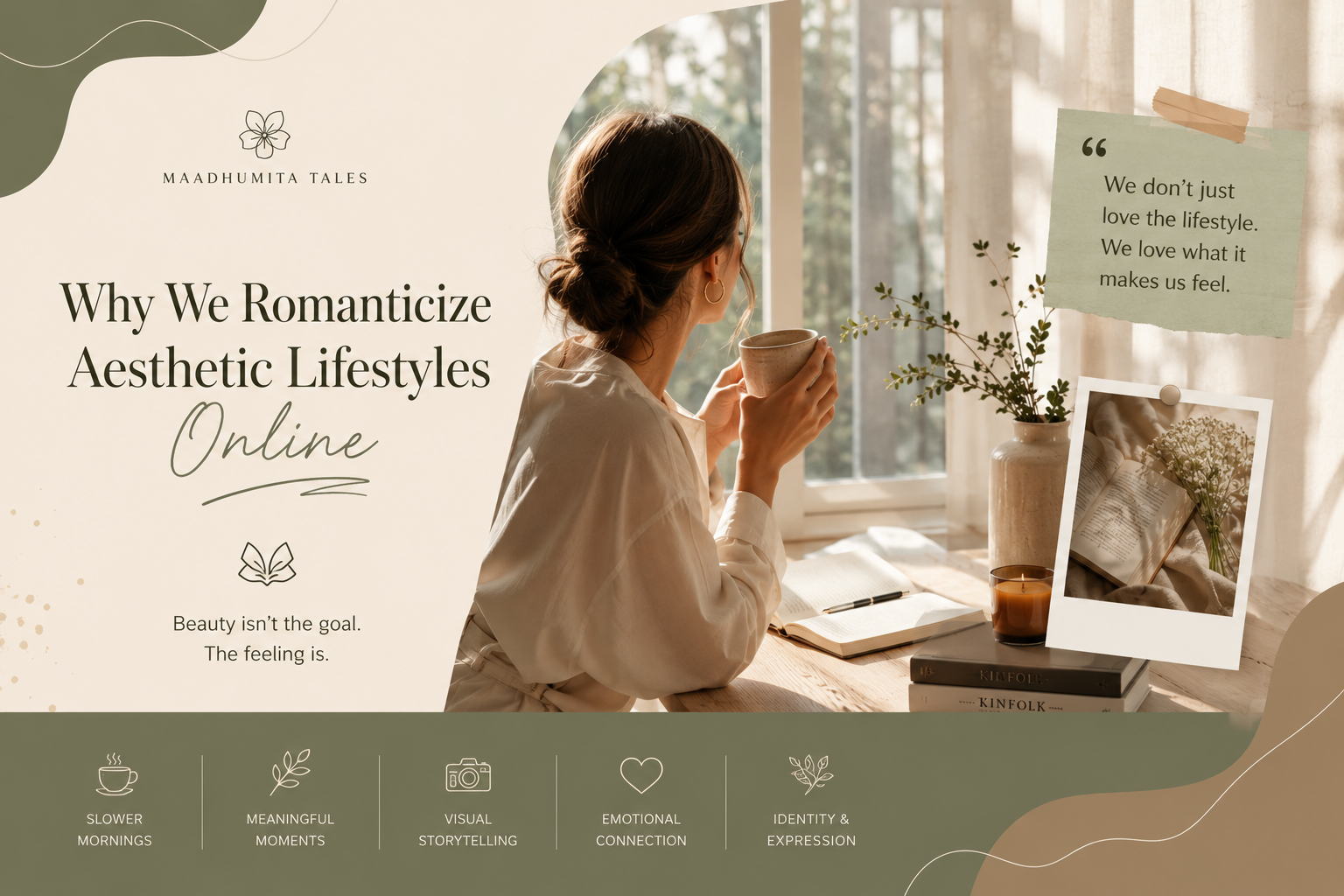
A girl pours coffee into a handmade ceramic mug.
Someone journals beside a sunlit window.
A creator films a slow morning routine with soft music playing in the background.
A neatly arranged bookshelf gathers thousands of likes.
And somehow, people all over the world stop scrolling for a second. Not because something extraordinary happened. But because it felt beautiful.
This is the strange power of the modern aesthetic lifestyle.
We are living in a time where ordinary moments are being transformed into visual experiences. Morning walks become content. Reading a book becomes content. Making breakfast becomes content.
And increasingly, people are not just consuming aesthetic lifestyles online. They’re aspiring to them. But why?
Why do perfectly curated everyday moments feel so attractive?
Why are millions of people drawn toward aesthetic content every day?
The answer goes much deeper than beautiful visuals. It sits at the intersection of psychology, identity, and human longing.
The World Feels More Chaotic Than Ever
To understand why aesthetic culture has become so powerful, we first need to understand the environment people are living in.
Modern life is noisy. Notifications never stop. Work follows people home. News cycles move relentlessly. Attention is constantly being pulled in different directions.
In contrast, aesthetic content offers something rare order.
A carefully arranged desk.
A clean living space.
A peaceful morning routine.
A visually balanced life.
Whether real or not, these images create a feeling of calm.
And often, people are not responding to the object itself.
They’re responding to what it represents.
Control.
Simplicity.
Peace.
We Are Not Buying the Lifestyle. We Are Buying the Feeling.
Most aesthetic trends are less about objects and more about emotions. People are not obsessed with candles. They’re obsessed with comfort. People are not fascinated by matcha.They’re fascinated by mindfulness People are not attracted to a perfectly designed room. They’re attracted to the feeling of having life figured out.
This is where the psychology behind aesthetic lifestyles becomes interesting. Humans naturally attach emotional meaning to visuals. A single image can communicate:
- Stability
- Freedom
- Creativity
- Sophistication
- Success
- Belonging
What people desire is rarely the image itself. It’s the emotional story behind it.
The Rise of Digital Identity
For previous generations, identity was mostly experienced offline. Today, identity is increasingly performed and interpreted online.
Every profile has become a personal publication.
Every feed tells a story.
Every post contributes to a larger narrative.
This has fundamentally changed how people think about self-expression.
Your room.
Your clothes.
Your coffee order.
Your travel photos.
Your playlists.
Everything can become part of your digital identity. And aesthetics help create coherence within that identity. People are no longer just living life. they are curating versions of it.
Why Aesthetic Content Feels So Personal
One reason aesthetic content spreads so easily is because it allows people to project themselves into it.
A motivational quote feels specific.
An opinion feels specific.
But a beautiful image often feels universal.
People look at a cozy reading corner and imagine themselves there.
They see a quiet café and imagine a different version of their day.
They see an organized workspace and imagine becoming more productive.
Aesthetic content becomes powerful because it invites participation.
It gives people space to dream.
And human beings have always been drawn to possibility.
Social Media Didn’t Create This Desire
It Simply Amplified It People often blame platforms for aesthetic culture. But the desire itself is not new. Humans have always romanticized life.
Through art.
Through literature.
Through photography.
Through cinema.
The difference is that social media culture has made aesthetic storytelling constant and accessible. What once belonged to magazines and films now appears on our phones every few minutes Aesthetic inspiration is no longer occasional.
It is continuous and because it is continuous, it begins shaping perception.
The Line Between Inspiration and Comparison
Aesthetic culture is not inherently negative. In many ways, it encourages people to appreciate everyday moments.
To slow down.
To notice beauty.
To create environments they enjoy living in.
But there is another side. When aesthetics become performance rather than expression, comparison enters the picture. People begin comparing:
- Homes
- Vacations
- Relationships
- Productivity
- Creativity
- Daily routines
What started as inspiration quietly becomes pressure.
Suddenly, ordinary life feels insufficient because someone else’s edited version appears more beautiful.
This is one reason why online perception can become complicated. The audience often sees the outcome. Not the reality behind it.
Expert Insight: We Are Really Searching for Meaning
The most successful aesthetic content is rarely successful because it is beautiful. It is successful because it makes people feel something.
A sunset photograph is not just a sunset. It represents freedom.
A travel video is not just a destination. It represents possibility.
A cozy apartment is not just interior design. It represents comfort.
People often believe they are chasing aesthetics. But what they are actually chasing is meaning. Aesthetics simply become the visual language through which meaning is expressed.
Why Aesthetic Lifestyles Are Trending
The popularity of aesthetic culture reflects something deeper happening in society.
People are becoming increasingly aware of how they experience life.
They want:
- More intentional routines
- More beautiful environments
- More meaningful experiences
- More personal expression
In a world dominated by speed and distraction, aesthetics offer a way to reconnect with presence.
This is why why aesthetic lifestyles are trending is not really a design question.
It is a human question.
People are searching for moments that feel emotionally richer.
The Difference Between Aesthetic Living and Aesthetic Performance
There is a subtle but important distinction. Aesthetic living is about experiencing beauty. Aesthetic performance is about appearing beautiful.
One is personal. The other is public. One creates fulfillment. The other often creates pressure.
The healthiest relationship with aesthetics happens when beauty enhances life rather than replacing it. When aesthetics become a tool for enjoyment rather than validation.
Conclusion
The rise of the aesthetic lifestyle is about much more than visual trends.
It reflects a deeper desire for meaning, identity, comfort, and self-expression.
People romanticize aesthetic lifestyles online because those images represent something many are searching for:
Slowness in a fast world.
Beauty in ordinary moments.
Order in chaos.
Connection in an increasingly digital life.
Perhaps that is why aesthetic content continues to resonate.
Not because people want perfect lives.
But because they want lives that feel meaningful.
And sometimes, a beautiful image becomes a reminder that meaning can exist in everyday moments.
FAQs
1. Why do people romanticize life online?
Because aesthetic content often represents emotions people want to experience in real life.
2. What is an aesthetic lifestyle?
An aesthetic lifestyle focuses on intentional, visually pleasing, and meaningful everyday experiences.
3. Why are aesthetic lifestyles trending?
They offer a sense of calm, identity, and self-expression in a fast-paced world.
4. How does social media influence aesthetic culture?
It constantly exposes people to curated lifestyles and visual storytelling.
5. What is digital identity?
Digital identity is how individuals present and express themselves online.
6. Is aesthetic content harmful?
It can inspire creativity, but excessive comparison may negatively affect well-being.
7. Why are people attracted to visual beauty?
Humans naturally respond to visuals that evoke emotion, meaning, and aspiration.