Not very long ago, most people only had one version of themselves.
You were simply who you were.
Your personality existed in conversations, friendships, workplaces, classrooms, family gatherings, and chance encounters. People formed opinions about you gradually. They discovered your humor over time. They learned your interests naturally. Your identity unfolded through real experiences rather than deliberate presentation.
Today, that process looks very different.
Before meeting someone, we often already know what they look like, where they travel, what they eat, what they believe, what music they listen to, what causes they support, and sometimes even what kind of person they want to be perceived as.
Without realizing it, we have entered an era where identity is no longer just experienced.
It is increasingly curated.
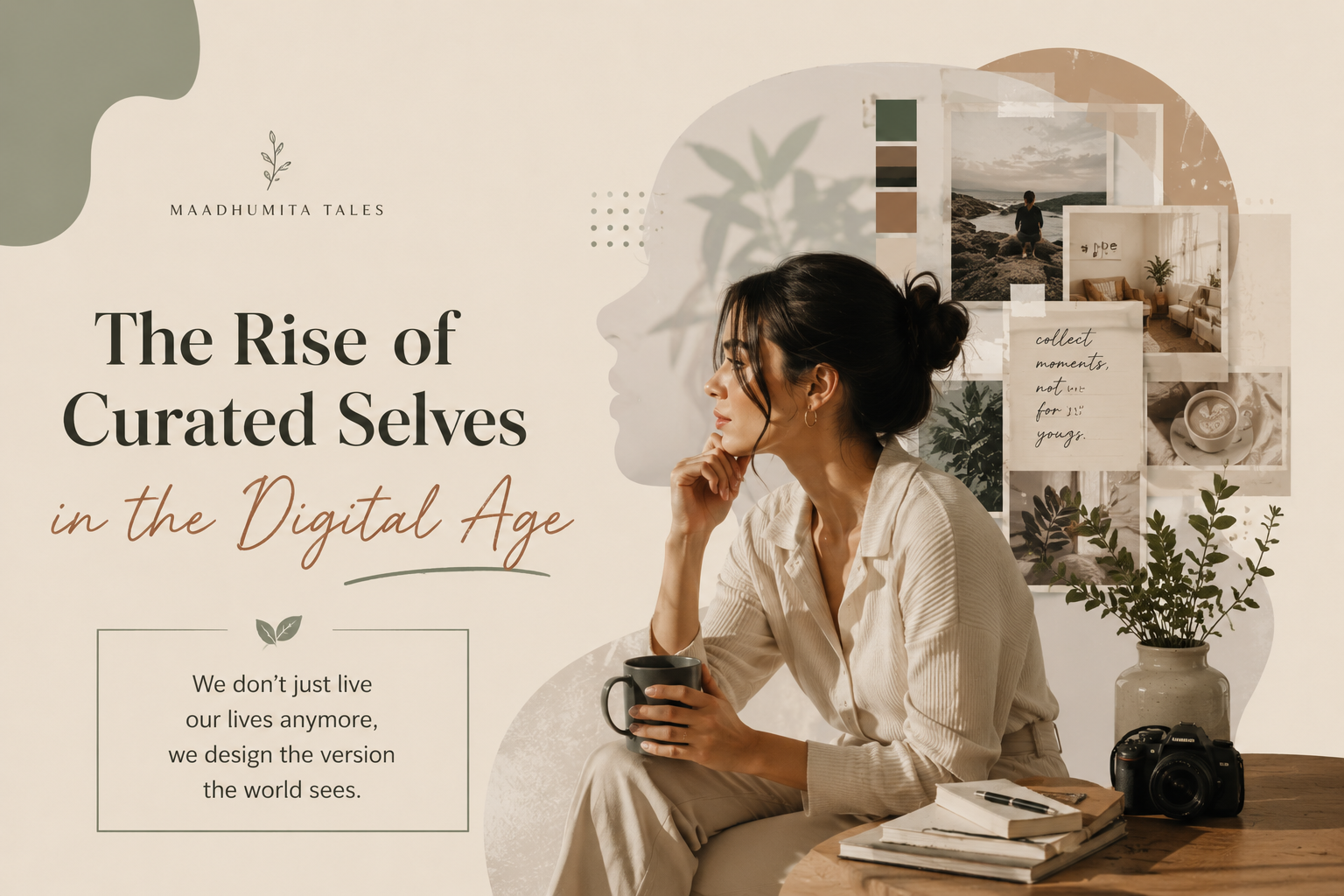
Every profile picture, caption, story, repost, playlist, aesthetic choice, and public opinion becomes part of a larger narrative. Consciously or unconsciously, people are participating in a constant process of online self-presentation. Not because they are fake, but because digital spaces have fundamentally changed how identity works.
The internet has turned personality into something visible.
And once something becomes visible, it becomes editable.
That single shift explains much of modern online behavior.
The Age of the Personal Narrative
Human beings have always told stories about themselves. The difference is that those stories were once spoken. Now they are designed.
Scroll through almost any social platform and you’ll notice that people rarely present random pieces of their lives. Instead, they present selected fragments that fit a larger narrative.
Someone becomes the traveler.
Someone becomes the entrepreneur.
Someone becomes the intellectual.
Someone becomes the minimalist.
Someone becomes the wellness enthusiast.
Someone becomes the creative.
These identities are rarely invented from nothing. Most are rooted in genuine interests and experiences. But they are often amplified, organized, and repeated until they become recognizable.
This is where digital identity begins to take shape. Identity online is not simply who you are. It is often the version of yourself that can be communicated most clearly.
The Pressure to Be Understandable
One of the strange consequences of social media is that people now feel pressure to be easy to categorize.
Algorithms reward clarity.
Audiences reward consistency.
Platforms reward repetition.
As a result, many people begin simplifying themselves. Not intentionally. But gradually.
The person with ten interests talks about only two.
The person with complex opinions shares only the most acceptable ones.
The person with contradictory qualities presents a cleaner version of themselves.
The internet favors recognizable identities because recognizable identities are easier to follow.
The problem is that human beings were never designed to be simple.
Most people are far more layered than their profiles suggest. Yet digital spaces often encourage people to reduce complexity in exchange for visibility.
Social Media Didn’t Create Performance. It Made It Continuous.
People often blame social media for making everyone perform. But performance itself is not new. People behave differently at work than they do with close friends. They behave differently on first dates than they do with family. Human beings have always adjusted their behavior based on context.
What has changed is the frequency. Before social media, those performances had an ending. Now the stage never really closes. There is always another post.
Another story.
Another update.
Another opportunity to reinforce an identity.
This is why discussions around social media behavior have become increasingly important.
People are no longer managing impressions occasionally.
They are managing them daily. Sometimes hourly.
The Quiet Rise of Perception Management
Many people dislike the phrase perception management because it sounds manipulative. But in reality, perception management happens constantly.
The clothes you wear.
The way you introduce yourself.
The words you choose.
The photos you share.
The opinions you express.
All of these shape how people understand you. Online platforms simply make this process more visible.
The interesting question is not whether people manage perception. The interesting question is how consciously they do it.
Some people carefully construct every detail. Others do it instinctively. Either way, the outcome is similar. People become aware that they are being watched. And awareness changes behavior.
The Strange Relationship Between Authenticity and Performance
One of the biggest cultural obsessions today is authenticity. Everyone wants to appear authentic.
Brands want it.
Creators want it.
Professionals want it.
Audiences demand it.
Yet the pursuit of authenticity has created an interesting paradox.
The moment people become aware that authenticity is valuable, they sometimes begin performing authenticity itself.
Messy desks become content.
Vulnerability becomes content.
Imperfection becomes content.
Even spontaneity becomes carefully documented. The result is a culture where people are often asking themselves:
“Am I expressing who I am?” Or, “Am I expressing the version of myself that will be received best?”
The line between those two questions is becoming increasingly blurry.
Identity Has Become a Creative Project
Perhaps the biggest shift of all is that identity is no longer viewed as something static.
For many people, it has become a project.
Something to build.
Something to refine.
Something to communicate.
This explains why conversations around personal branding have expanded far beyond entrepreneurs and business owners.
Today, almost everyone participates in some form of identity construction.
Students do it.
Professionals do it.
Creators do it.
Job seekers do it.
Even people who claim not to care about branding often engage in subtle forms of self-presentation.
Because whether we acknowledge it or not, modern life increasingly rewards visibility.
And visibility naturally encourages curation.
Expert Insight: The Real Risk Isn’t Curation
Curation itself is not the problem. In many ways, curation is inevitable.
Every story requires selection.
Every introduction requires simplification.
Every profile requires choices.
The real risk appears when the gap between identity and presentation becomes too large.
When people spend more energy maintaining a version of themselves than understanding themselves.
When performance replaces self-awareness.
When visibility becomes more important than authenticity.
That is often where disconnection begins. Not from audiences. But from oneself.
Conclusion
The question is no longer whether people curate their personalities online. Most do. The more interesting question is why.
Perhaps people are searching for belonging.
Perhaps they are searching for recognition.
Perhaps they are searching for meaning.
Or perhaps they are simply trying to make sense of themselves in a world where identity is increasingly public.
What makes the digital age fascinating is that we are all participating in the same experiment.
For the first time in history, millions of people are simultaneously creating, editing, displaying, and negotiating their identities in public view.
Some do it strategically.
Some do it unconsciously.
But almost everyone does it. And somewhere between self-expression and self-presentation lies the story of modern identity itself.
FAQs
1. What is digital identity?
Digital identity is how individuals present and are perceived online through content, behavior, and communication.
2. Why do people curate their personality online?
To communicate identity, gain recognition, build connections, and shape perception.
3. Is online self-presentation always fake?
No, most online identities are based on real traits, but selectively presented.
4. How does social media influence identity?
It encourages people to consciously think about how they are perceived.
5. What is perception management?
It is the process of influencing how others understand and interpret you.
6. Is personal branding the same as digital identity?
Personal branding is intentional positioning, while digital identity is broader and includes all online signals.
7. Can social media affect self-perception?
Yes, repeated online behaviors can influence how people view themselves over time.