A few years ago, creating something remarkable required time.
You had to write, rewrite, sketch, edit, photograph, brainstorm, and experiment. Today, many of those tasks can happen in minutes. An AI tool can generate a logo, write a blog, create a campaign, design a presentation, and even imitate the tone of your favorite writer before you’ve finished your morning coffee.
For businesses, it’s revolutionary.
For branding, it’s complicated.
Because while artificial intelligence has made creating content easier than ever, it has also made originality much harder to recognize. When everyone has access to the same tools, the question is no longer, “Who can create content?” Almost everyone can.
The real question becomes, “Who can create meaning?”
That is where the future of branding is quietly changing.
AI Can Generate Content. It Cannot Generate Context.
Imagine asking ten different people to write about confidence using the same AI prompt.
The words may change.
The structure may vary.
The examples might be different.
But something often feels familiar.
That’s because AI is trained on patterns. It predicts what is most likely to come next. It is remarkably good at recognizing what already exists.
Human beings work differently. We don’t just produce information—we create meaning from lived experience.
The entrepreneur who failed twice before building a successful company has a story AI cannot invent.
The designer whose childhood shaped their sense of aesthetics has a perspective no algorithm can replicate.
The consultant who has spent years understanding human behavior brings observations that don’t exist inside a dataset.
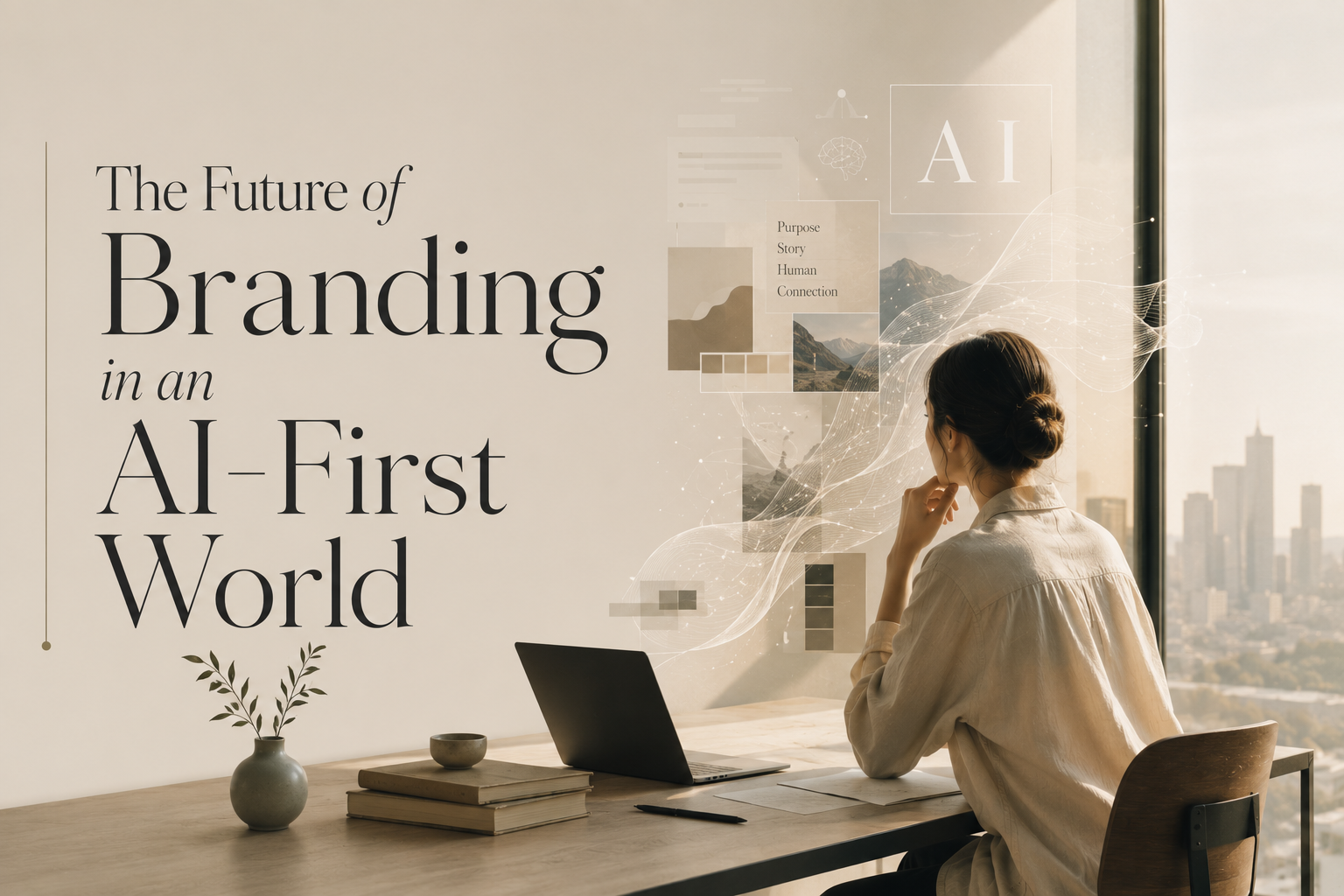
This is why the future of AI branding isn’t about replacing human creativity.
It’s about revealing what only humans can contribute.
The Most Valuable Brand Asset Is Becoming Invisible
For decades, branding focused heavily on visible elements.
A logo.
A color palette.
Typography.
Photography.
Visual identity.
These things still matter.
But in an AI-first world, they are becoming easier to produce. What is becoming difficult to copy is perspective.
Two companies may use the same AI tools.
Two creators may generate equally polished content.
Yet one brand feels unforgettable while the other disappears into the endless stream of similar ideas.
The difference isn’t design.
It’s thinking. People aren’t looking for perfect brands anymore. They’re looking for brands that have something genuine to say.
When Everyone Sounds Smart, Wisdom Becomes the Differentiator
Artificial intelligence has dramatically increased the amount of content available online.
Articles are written faster.
Videos are produced daily.
Ideas spread instantly.
Ironically, this abundance creates a new problem.
Noise. We’re entering an era where information is everywhere but insight is increasingly rare.
The brands that will stand out won’t necessarily publish the most content.
They’ll publish the clearest thinking.
This changes the purpose of branding.
Instead of asking, “How often should we post?” businesses will begin asking, “What perspective can only we offer?”
That shift will define the future of branding.
Authenticity Is Becoming More Valuable, Not Less
Many people worry that AI will make branding feel less human. Perhaps the opposite will happen. The more synthetic content people encounter, the more they will value authenticity.
Think about handwritten letters in the age of email.
Vinyl records in the age of streaming.
Independent cafés surrounded by global chains.
Scarcity creates value.
Human expression is becoming that scarce resource. This is why brand authenticity will matter even more in the coming years.
People won’t admire brands simply because they look polished. They’ll remember brands that feel honest.
Not perfect. Human.
The New Competitive Advantage Isn’t Better Technology
Every business will eventually have access to similar AI tools. Technology always becomes accessible over time. What remains difficult to replicate is judgment.
Knowing what not to say. Understanding cultural nuance.
Recognizing emotion.
Reading a room.
Interpreting silence.
These aren’t technical skills.
They’re deeply human ones.
AI can suggest hundreds of headlines.
It cannot tell you which one genuinely resonates with your audience because it cannot experience that audience the way people do.
The future belongs to businesses that combine technological efficiency with human sensitivity.
Storytelling Is Becoming the Last Uncopyable Advantage
Imagine asking AI to write a story about resilience.
It will probably produce something coherent.
Now imagine listening to someone describe rebuilding their life after losing everything.
The difference isn’t grammar.
It’s reality.
Stories rooted in lived experience carry emotional texture.
They include hesitation, contradiction, humor, uncertainty, and imperfection.
Those details create trust.
This is why the role of storytelling in AI-powered branding will become even more important.
Technology can imitate language.
It struggles to imitate life.
Brands that invest in genuine stories will continue creating emotional connections that templates simply cannot reproduce.
Personal Branding Will Matter More Than Corporate Branding
As AI becomes capable of producing polished business communication, audiences will increasingly look for the people behind the brands.
Who is speaking? What do they believe?
Have they actually experienced what they’re talking about?
Trust is slowly shifting away from institutions and toward individuals.
Founders.
Creators.
Consultants.
Experts.
People trust people because people can be questioned, challenged, and understood.
A logo cannot build relationships. A person can.
This is one reason how AI is changing personal branding is becoming such an important conversation.
Technology may automate communication. It cannot automate credibility.
The Brands We’ll Remember Won’t Be the Loudest
The internet has never had a shortage of content. What it has always lacked is clarity. In the future, brands won’t compete for attention alone. They’ll compete for meaning.
Some will produce thousands of posts.
Others will produce fewer, but each one will carry an unmistakable perspective.
Those are the brands people will remember.Not because they mastered AI. But because they mastered themselves.
Expert Insight: AI Will Change Branding, But It Won’t Change People
Technology changes rapidly. Human psychology evolves much more slowly. People will still seek belonging.
They will still value trust.
They will still remember stories over slogans.
They will still respond to empathy more than efficiency.
The tools may change. The reasons people connect never really do.
That is why human centered branding is not becoming less important because of AI. It is becoming essential.
The Future Isn’t Human vs AI. It’s Human With AI.
Perhaps the biggest mistake is believing the future is a competition.
It isn’t. The strongest brands won’t reject artificial intelligence. Nor will they depend on it completely. They will use AI to remove repetitive work.
To explore ideas faster. To improve productivity.
But they’ll rely on people to provide curiosity, judgment, emotional intelligence, creativity, and meaning.
Technology can accelerate execution. Only humans can decide what is worth creating in the first place.
Conclusion
The future of AI branding isn’t about machines replacing marketers, designers, or storytellers.
It’s about raising the standard for what makes a brand worth remembering. When everyone can create polished content, polish loses its power.
When everyone has access to intelligence, wisdom becomes rare. When everyone can generate words, genuine stories become unforgettable.
The brands that thrive in the coming years won’t simply be the ones using AI. They’ll be the ones using it without losing their humanity.
Because algorithms may help people discover your brand. But it’s still your ideas, your perspective, and your story that will make them stay.
FAQs
1. What is AI branding?
AI branding is the use of artificial intelligence to support brand strategy, content, design, and customer experiences.
2. How is AI changing branding?
AI speeds up content creation, personalization, and analysis while increasing the importance of authenticity.
3. Will AI replace personal branding?
No. AI can support branding, but trust and credibility still come from human experience.
4. Why is storytelling important in the AI era?
Authentic stories create emotional connections that AI-generated content cannot fully replicate.
5. What is human-centered branding?
It focuses on empathy, authenticity, and meaningful relationships rather than technology alone.
6. Can AI build authentic brands?
AI can assist, but authenticity comes from real people, experiences, and values.
7. What is the future of branding with AI?
The future combines AI efficiency with human creativity, strategy, and storytelling.