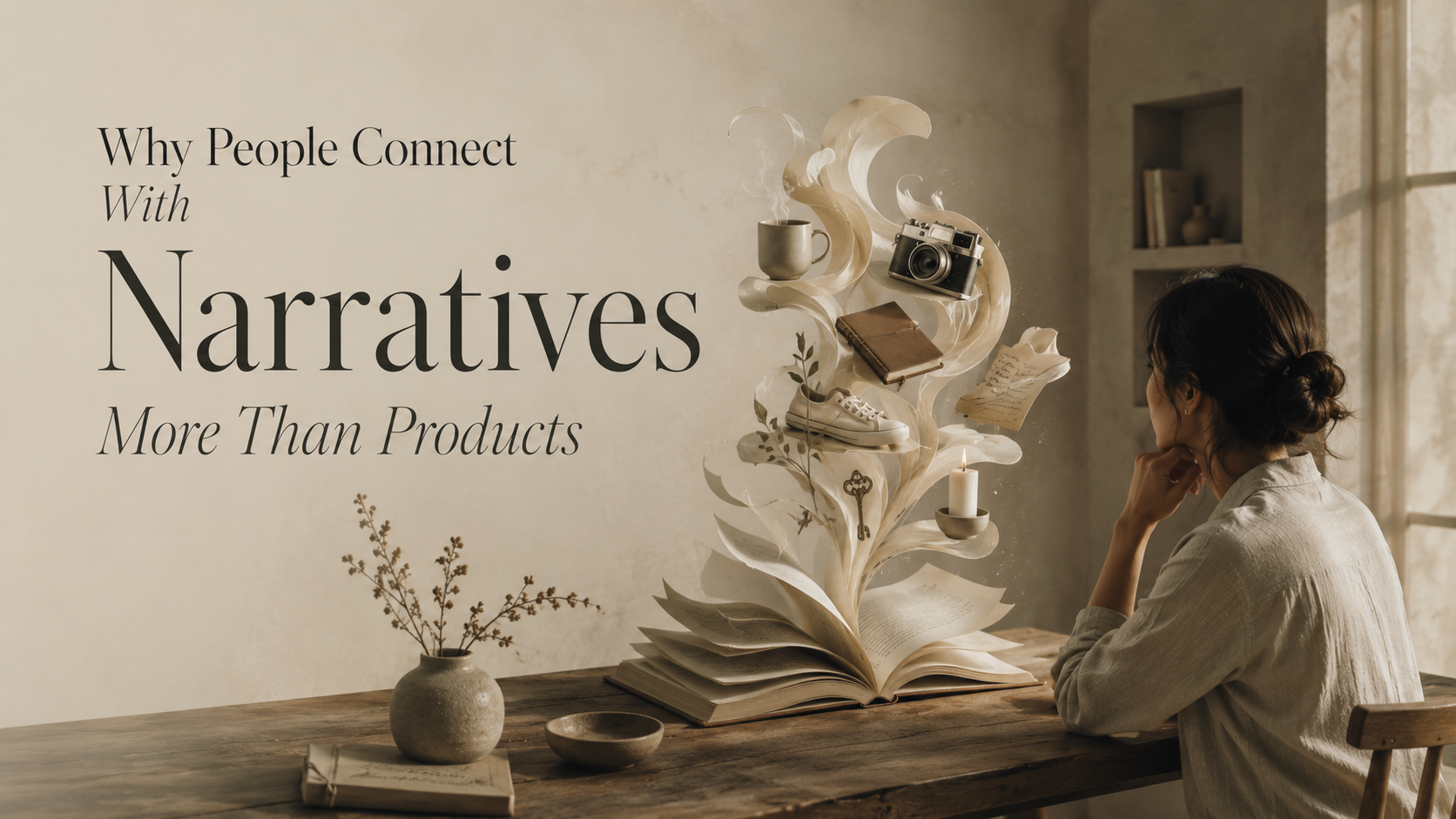
Before there were brands, there were stories.
Long before advertisements appeared on our screens, people gathered around fires, passed down family histories, shared myths, and told stories that explained the world around them. Civilizations remembered stories. Religions spread through stories. Cultures survived because someone kept telling stories worth remembering.
Very little has changed.
Today, we scroll instead of gathering around a fire, but our brains still respond to stories in exactly the same way.
That is why you rarely remember an advertisement for a product.
But you remember the story behind it.
The product may solve a problem.
The story gives it meaning.
And meaning is what people truly connect with.
We Rarely Buy What Something Is. We Buy What It Means.
Imagine someone hands you two identical notebooks.
The first is simply described as “a premium notebook.”
The second belonged to a writer who carried it while travelling across different countries, filling each page with ideas that eventually became a bestselling novel.
The notebook hasn’t changed.
Your perception has.
Suddenly, it feels valuable—not because of the paper, but because of the story attached to it.
This is the foundation of consumer psychology. Human beings don’t assign value based only on function. We assign value based on meaning, memory, and emotion.
Stories create all three.
Products Solve Problems. Stories Solve Distance.
Every product begins as an object.
A watch tells time.
A chair offers comfort.
A jacket keeps you warm.
But when a story enters the picture, those objects begin carrying something else.
Identity. Aspiration. Belonging. Hope.
People don’t simply wear certain shoes because they are comfortable. They wear them because of what those shoes represent.
The same is true for cars, perfumes, books, coffee shops, and even personal brands. Stories reduce the distance between a product and a person.
Without a story, a product asks, “What can I do?” With a story, it quietly asks, “What could I mean in your life?”
Our Brains Remember Stories Better Than Specifications
Think back to a presentation you’ve attended. You probably don’t remember every statistic.
But you’ll likely remember the one personal story that made everyone pause.
Our brains naturally organize information through narrative. Facts are easier to forget because they exist in isolation. Stories create relationships between ideas.
They introduce characters.
Conflict. Emotion. Resolution.
That sequence gives information a structure our minds naturally hold onto. This is why brand storytelling has become one of the most powerful tools in communication.
It doesn’t replace information. It gives information a heartbeat.
Emotion Is the Shortcut to Memory
Memory isn’t built only through logic.
It’s built through emotion. You may forget the features of a product within days.
But you’ll remember how a campaign made you feel years later.
That’s why the most successful examples of emotional branding rarely begin by talking about products.
They begin by talking about people.
A father teaching his daughter to ride a bicycle.
An entrepreneur rebuilding after failure.
A student leaving home for the first time.
The product quietly enters the story instead of becoming the story. And that’s precisely why people remember it.
Stories Help Us See Ourselves
Perhaps the biggest reason narratives work is because people don’t enter stories as spectators.
They enter them as participants.
While watching a film or reading a book, we constantly ask ourselves silent questions.
“What would I do?” “I’ve felt that before.”
“That reminds me of someone I know.”
Stories become mirrors.
The same thing happens in storytelling marketing.
People aren’t looking for brands that talk endlessly about themselves. They’re looking for brands that understand them. The strongest stories don’t say, “Look at us.” They quietly whisper, “We understand you.”
Every Brand Is Really Telling a Story About Identity
Whether intentional or not, every brand communicates a narrative. Luxury brands often tell stories about aspiration.
Local businesses tell stories about community. Sustainable companies tell stories about responsibility.
Personal brands tell stories about perspective.
The logo isn’t the story.
The product isn’t the story.
The story is the meaning people attach to both.
That meaning shapes brand perception far more than features ever will.
Why So Many Campaigns Fail to Connect
It’s tempting to assume bigger budgets create better campaigns. But audiences rarely fall in love with production quality alone. They connect with honesty.
With tension. With something that feels human.
Many campaigns fail because they begin with the question, “How do we sell this?”
The stronger question is, “What human truth does this product belong to?”
The answer often changes everything. Because stories aren’t created by adding emotion at the end. They’re created by beginning with emotion.
Storytelling Is About Recognition, Not Persuasion
One of the biggest misconceptions about narrative marketing is that stories exist to persuade people.
In reality, the best stories don’t persuade.
They help people recognize themselves.
When someone feels seen, understood, or emotionally reflected, trust naturally follows.
The sale becomes a consequence.
Not the objective.
That’s why storytelling feels less like advertising and more like conversation.
Expert Insight: Every Great Brand Starts With a Human Truth
Behind every memorable brand is usually a simple observation about people.
Perhaps it’s the desire to belong.
The fear of missing out.
The comfort of nostalgia.
The excitement of possibility.
The pride of achievement.
Products evolve.
Markets change.
Technology moves quickly.
Human emotions don’t.
Brands that understand people before they understand marketing create stories that remain relevant long after campaigns disappear.
So, What Are People Really Buying?
People rarely buy products in isolation.
They buy confidence.
Comfort.
Status.
Hope.
Belonging.
Progress.
Identity.
The product simply becomes the vehicle through which those emotions are experienced. This is why why people connect with stories over products isn’t really a marketing question.
It’s a human question. We’ve always understood the world through narratives. Brands simply became another way of telling them.
Conclusion
The most memorable brands don’t begin with products. They begin with people.
They understand that while features explain what something does, stories explain why it matters.
In a crowded marketplace, products can often look similar. Stories cannot. Because every meaningful story is rooted in something deeply human.
And that’s what makes brand storytelling so powerful. It doesn’t ask people to remember specifications. It gives them something worth remembering.
FAQs
1. What is brand storytelling?
It’s the practice of using stories to communicate a brand’s purpose, values, and emotional meaning.
2. Why is storytelling important in marketing?
Stories create emotional connections, making brands more memorable and relatable.
3. How does storytelling influence buying decisions?
People often make emotional decisions first and justify them with logic later.
4. Why do people connect with stories more than products?
Stories create meaning, while products simply provide function.
5. What is emotional branding?
Emotional branding builds relationships by connecting with people’s feelings and experiences.
6. How does storytelling improve brand perception?
It creates trust, authenticity, and a stronger emotional identity for the brand.
7. Can storytelling help personal brands?
Yes. Authentic stories make personal brands more relatable, memorable, and trustworthy.