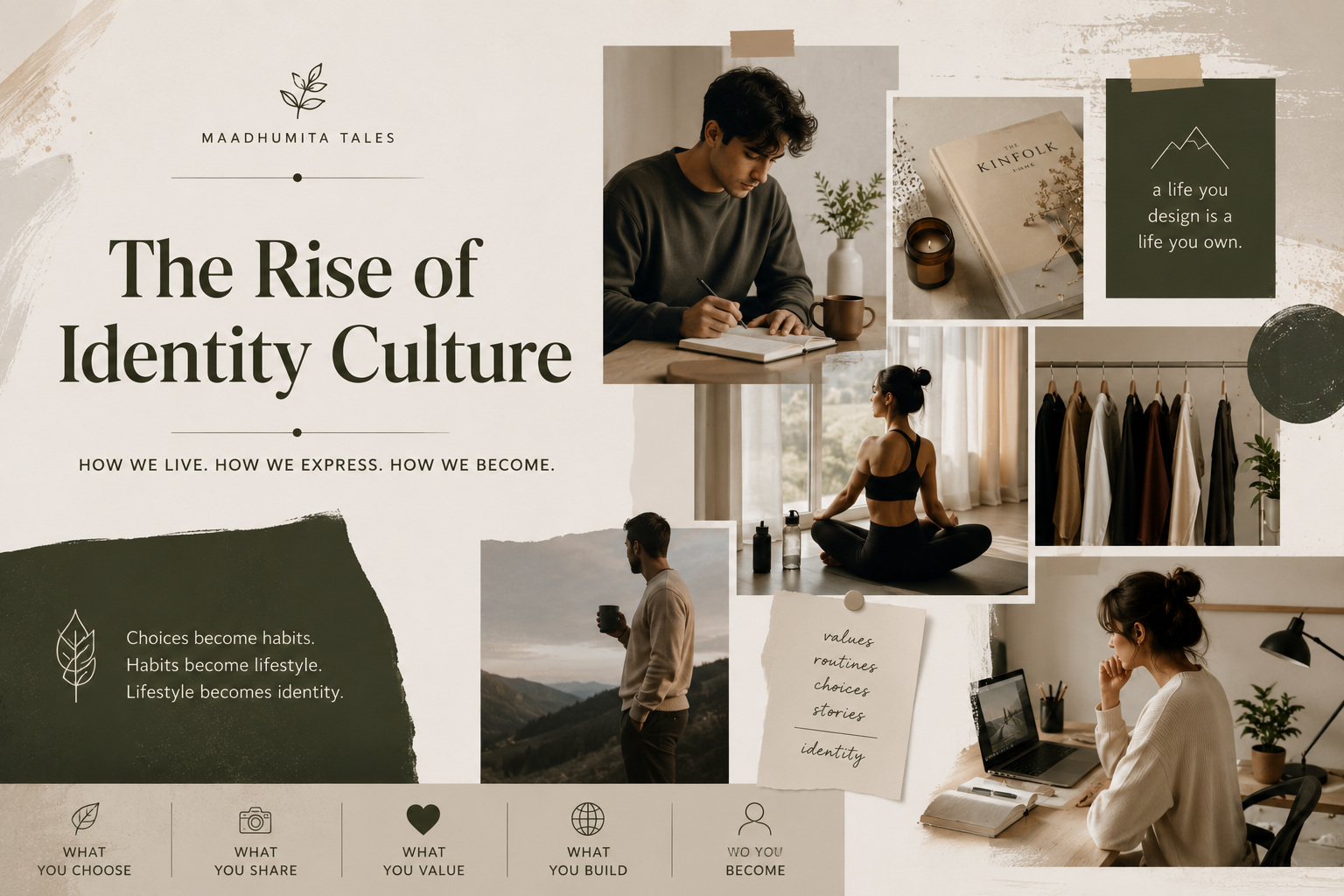
A few years ago, people talked about hobbies. Today, they talk about identities.
Someone isn’t just interested in fitness anymore—they’re part of a wellness lifestyle.
Someone isn’t simply reading books—they belong to a reading aesthetic.
Someone isn’t decorating their apartment—they’re creating a visual identity.
What was once a preference has increasingly become a personality. And what was once a lifestyle choice has become a form of self-definition.
This shift sits at the center of what many sociologists, marketers, and cultural observers are beginning to call identity culture.
It explains why people care so deeply about aesthetics, personal values, routines, and the stories they tell about themselves online.
More importantly, it explains why modern life feels increasingly centered around the question:
“Who am I, and how do I express that to the world?”
We No Longer Just Live Life. We Curate It.
One of the defining characteristics of modern culture is that everyday choices now carry symbolic meaning.
The coffee shop you visit.
The clothes you wear.
The podcasts you listen to.
The books displayed on your shelf.
The cities you travel to.
The habits you share online.
None of these things are simply activities anymore.
They have become signals.
They communicate taste.
They communicate values.
They communicate identity.
In previous generations, identity was often inherited through family, geography, religion, or profession.
Today, identity is increasingly assembled through choices.
People build themselves through what they consume, what they support, what they display, and what they associate with.
This is one reason aesthetic living has become such a powerful cultural force.
Aesthetics are no longer just about appearance. They have become a language of self-definition.
Why Identity Matters More Today
Perhaps the biggest reason for the rise of identity culture is that modern life offers more freedom than ever before.
That sounds positive—and often it is.
But freedom also creates uncertainty.
When there are endless career paths, lifestyles, communities, beliefs, and possibilities available, people naturally begin searching for anchors.
They want a sense of belonging.
A sense of direction.
A sense of self.
Identity provides that anchor. It helps people answer questions like:
Who am I?
What do I value?
Where do I belong?
What kind of life do I want to build?
In a world filled with options, identity creates stability. And aesthetics often become the visual expression of that stability.
The Era of Lifestyle Identity
Not long ago, products were sold based on function. Today, products are often sold based on identity. People don’t just buy running shoes. They buy a version of themselves that feels disciplined, active, and healthy. People don’t just buy journals. They buy the idea of becoming reflective and intentional. People don’t just buy clothing. They buy belonging.
This shift explains the rise of lifestyle identity.
Consumers increasingly connect with things that reinforce how they see themselves—or how they hope to see themselves.
The product becomes secondary. The identity becomes primary.
Social Media Accelerated Everything
While identity culture was already developing, social media dramatically accelerated it.
Platforms created an environment where identity could be displayed, refined, and reinforced every day.
Every profile became a personal gallery.
Every post became a statement.
Every aesthetic choice became visible.
As a result, people became more conscious of how they present themselves. Not necessarily because they are being inauthentic. But because visibility changes behavior.
When identity becomes public, people naturally spend more time shaping it. This is why conversations around identity culture in social media continue to grow.
Social media didn’t invent identity. It simply gave it a stage.
The Rise of Self-Expression as a Cultural Value
Modern culture places enormous importance on authenticity and individuality.
People are encouraged to:
Find their voice.
Express themselves.
Build a personal narrative.
Stand out. Be unique.
At first glance, this seems entirely positive.
But it has also transformed self expression into something people actively work on rather than something that happens naturally.
Expression becomes intentional. Identity becomes visible. And aesthetics become tools for communication.
The result is a culture where personal expression is no longer limited to art, fashion, or creativity. It extends into almost every area of life.
When Aesthetic Living Becomes Personal Branding
An interesting consequence of identity culture is that personal life and public image are becoming increasingly connected.
Many people who have never considered themselves marketers are participating in forms of personal branding.
They are creating recognizable styles. Developing consistent aesthetics. Sharing curated routines. Communicating values through visual choices. Not because they are selling products. But because modern identity itself has become visible. In many ways, aesthetic living and personal branding now overlap.Both involve intentionally shaping how a person is understood.
The Hidden Tension Within Identity Culture
While identity culture offers opportunities for creativity and self-expression, it also creates pressure.
The pressure to have a clear identity.
The pressure to define yourself.
The pressure to know exactly who you are.
The pressure to communicate it effectively.
Ironically, identity is often most authentic when it is allowed to evolve. Yet digital culture frequently rewards certainty.
People feel encouraged to choose labels, aesthetics, communities, and narratives that make them easier to understand.
But human beings are rarely that simple. Most people contain contradictions. Multiple interests. Changing values. Different versions of themselves. The challenge is learning how to express identity without becoming trapped by it.
Expert Insight: The Real Appeal of Aesthetic Living
The popularity of aesthetic living is often misunderstood as vanity. In reality, it reflects something much deeper.People are not simply searching for beautiful spaces, curated wardrobes, or visually pleasing routines.
They are searching for meaning.Aesthetic living offers a way to make everyday life feel intentional.
It transforms ordinary moments into experiences.
It creates a sense of connection between values, environment, and identity.
That is why the trend continues to grow.
Because beneath the visuals lies a deeper human desire to feel aligned with the life we are creating.
Conclusion
The rise of identity culture reveals something important about the modern world. People are no longer satisfied with simply existing within systems and roles. They want to actively participate in defining who they are.
Aesthetic living, lifestyle identity, self-expression, and personal branding are all different expressions of the same cultural movement. A movement toward intentional identity.
Whether that movement ultimately creates greater freedom or greater pressure remains an open question.
But one thing is clear. The future of culture will not only be shaped by what people consume. It will be shaped by the identities they choose to build around it.
FAQs
1. What is identity culture?
Identity culture refers to the growing importance of expressing and defining personal identity through lifestyle, values, and aesthetics.
2. Why is identity culture becoming more popular?
Modern life offers more choices than ever, making identity an important source of meaning and belonging.
3. What is aesthetic living?
Aesthetic living involves intentionally designing experiences, environments, and routines that reflect personal values and identity.
4. How does social media influence identity culture?
Social media makes identity more visible and encourages people to consciously shape how they are perceived.
5. Is aesthetic living the same as personal branding?
Not exactly, but both involve communicating identity through consistent choices and visual expression.
6. Why do people build lifestyle identities?
Lifestyle identities help people express values, create belonging, and make sense of themselves.
7. Can identity culture become harmful?
It can create pressure when people feel forced to define themselves too rigidly or perform an identity constantly.