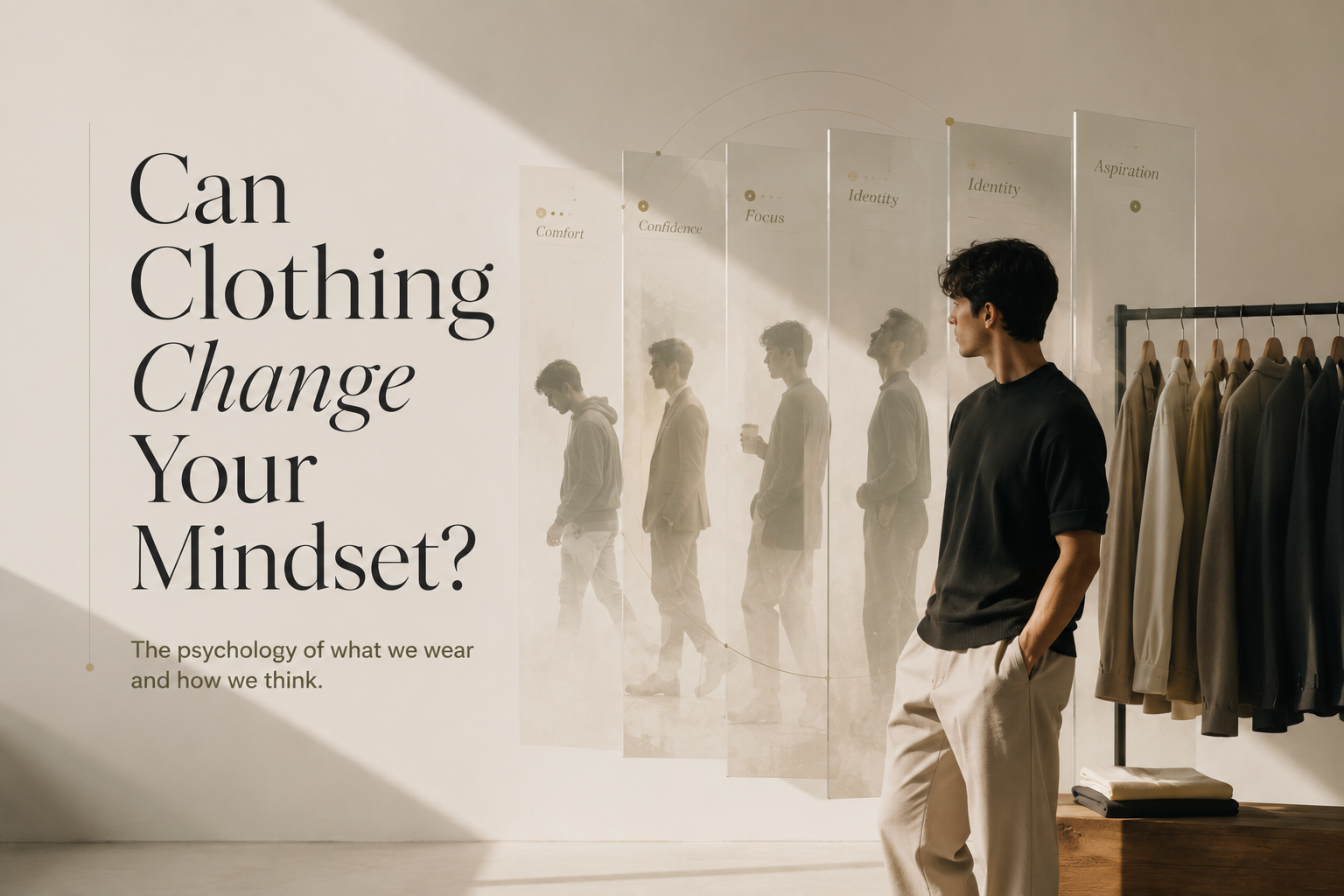
There’s a reason you don’t feel exactly the same in every outfit.
Think about the last time you wore a tailored blazer to an important meeting. Maybe you spoke a little more confidently. You sat up straighter. You chose your words more carefully.
Now think about a lazy Sunday spent in oversized pajamas. Chances are your body relaxed, your pace slowed, and your mind shifted into rest mode almost automatically.
The work didn’t change. Neither did your personality.
So what changed? Your clothes.
It might sound surprising, but psychology suggests that what we wear doesn’t simply influence how others see us it also influences how we see ourselves. This phenomenon is known as enclothed cognition, and it challenges one of our biggest assumptions: that clothing is only about appearance.
In reality, clothing can quietly shape the way we think, behave, and even perform.
More Than Fabric: The Science Behind Enclothed Cognition
The term enclothed cognition was introduced by researchers who wanted to understand whether clothing could influence cognitive performance.
In one famous experiment, participants were asked to wear a white coat while completing attention-based tasks. Some were told it was a doctor’s coat, while others were told it belonged to a painter.
The coat was identical.
The only difference was the meaning attached to it.
Those who believed they were wearing a doctor’s coat performed better on tasks requiring concentration and attention to detail.
The conclusion wasn’t that the fabric had magical powers.
It was that the symbolic meaning of clothing influences the way our brains behave.
What we wear affects not only how we look but how we think.
Every Outfit Tells a Story to Your Brain
When most people think about clothing psychology, they assume it only relates to first impressions.
But the first impression your clothes create is often with you.
A crisp shirt may remind your brain that it’s time to focus.
Sportswear signals movement and energy.
Traditional clothing may evoke a sense of heritage or belonging.
A uniform can create responsibility.
Your wardrobe acts like a collection of psychological cues, quietly telling your mind how to approach the day.
Without noticing, we respond to those cues.
Confidence Doesn’t Come From Clothes But Clothes Can Unlock It
People often say, “Confidence comes from within.”
That’s true.
But psychology suggests something equally important.
External experiences can influence internal states.
Think about athletes.
Many have rituals before competition. The same shoes. The same jersey. The same routine.
The clothing itself doesn’t create skill.
It activates a mindset.
The same happens in everyday life.
Wearing something that feels aligned with who you want to become can help reduce hesitation and increase confidence.
This is why conversations around confidence and clothing aren’t about vanity.
They’re about behavior.
Why We Dress Differently for Different Moments
Imagine attending a job interview in beachwear. Or going to a wedding in gym clothes.
Technically, you could. But it would feel wrong. That’s because clothing helps us transition between social roles.
Throughout a single week, one person may become:
- A leader in the office.
- A friend over dinner.
- A parent at home.
- A speaker on stage.
- A student in a workshop.
Clothing helps the mind adapt to each context.
It becomes part of the psychological shift between identities.
Fashion Is Emotional Before It Is Visual
We often describe clothes using visual words.
Elegant.
Minimal.
Bold.
Classic.
But behind every style choice is usually an emotion.
Some days we dress for comfort because we’re overwhelmed.
Some days we choose bright colours because we want energy.
Some days we wear black because we want simplicity.
Fashion has always been emotional.
The visual outcome is simply the final expression. This is one of the core ideas behind fashion psychology.
Our wardrobe often reflects emotional needs long before it reflects aesthetic preferences.
The Clothes We Wear Also Shape Memory
Have you noticed how certain outfits remind you of specific phases of your life?
A graduation gown.
A wedding outfit.
Your first office suit.
A school uniform.
Clothing carries memory.
Sometimes we keep old clothes not because we’ll wear them again, but because they remind us of who we were.
The relationship between clothing and identity is far deeper than trends.
Our wardrobes quietly become timelines.
Dressing Is a Conversation With Your Future Self
One of the most interesting ways to think about personal style is this:
Every morning, you’re choosing who you’ll spend the day becoming.
Not pretending. Preparing.
If you dress only for the person you were yesterday, you remain psychologically connected to yesterday’s version of yourself.
If you dress intentionally for the responsibilities ahead, your mindset often begins shifting before the day even starts.
That’s why many professionals speak about “getting into work mode” simply by changing clothes.
The change isn’t only physical. It’s mental.
Expert Insight: Style Should Support Identity, Not Replace It
One misconception about personal style is that dressing well is about impressing others.
The deeper purpose is alignment.
The most powerful wardrobes don’t hide who you are.
They make it easier for your identity to show up consistently.
Clothing becomes most effective when it reflects your values, lifestyle, personality, and aspirations not when it imitates someone else’s aesthetic.
Confidence grows when what you wear feels believable. Not performative.
So, Can Clothes Really Change Your Mindset?
The answer is both yes and no. Clothes cannot replace self-belief.
They cannot create expertise.
They cannot manufacture confidence where none exists.
But they can influence the psychological state from which those qualities emerge. They can remind you of your intentions.
Support your focus.
Reinforce your identity.
Reduce hesitation.
And sometimes, that’s enough to change how you show up in the world. Perhaps the real power of clothing isn’t that it changes who you are.
It’s that it helps you access parts of yourself that were already there.
Conclusion
The science of enclothed cognition reminds us that getting dressed is more than a daily routine. It’s a psychological ritual.
Every choice from colours and fabrics to silhouettes and structure sends subtle messages to the brain. Those messages influence posture, confidence, attention, and behavior in ways we rarely notice.
The goal isn’t to own expensive clothes or follow every trend. It’s to build a wardrobe that supports the person you’re becoming. Because in the end, clothing isn’t just about making an impression.
Sometimes, it’s about changing the conversation you have with yourself before the world even sees you.
FAQs
1. What is enclothed cognition?
It’s the psychological effect where clothing influences how we think, feel, and perform.
2. Can clothes really change your mindset?
Yes. Research shows clothing can influence confidence, focus, and behavior.
3. How does clothing affect confidence?
The right clothing can reinforce positive self-perception and increase confidence.
4. What is clothing psychology?
It studies how clothing influences emotions, behavior, and social perception.
5. Does fashion affect mental performance?
Certain clothing can improve focus and encourage mindset shifts through symbolic meaning.
6. Why do professionals dress intentionally?
Intentional dressing helps prepare the mind for specific roles, responsibilities, and environments.
7. Is personal style connected to identity?
Yes. Personal style often reflects values, personality, experiences, and self-expression.